Is Your Brand Ready for Advertising?
Many marketers or founders are rushing to launch ad campaigns when they have a “functioning” website and/or their product/service is ready. Is that good for some quick wins and getting the low-hanging fruits? Yes. Are these the strategic steps in terms of growing and scaling the brand? Absolutely not!
In this article, we’ll uncover the 7 critical pillars — from funnel health to omnichannel strategy — that you must establish before hitting "publish" on your first campaign.

Why a "Working Site” is Just the Starting Point
Having working in site is far from enough. It’s not the early 2000s anymore. Competition is high, and algorithms are strict. You will spend a ton, Why am I not getting enough leads or sales. What’;s happening is platform algorithms are giving your landing pages lower ad ranks due to poor optimization and also your competitors have simply mastered user experience and funnel of the website, so you are mostly burning cash.
Here’s why a good enough website is not enough:
You are offering a poor mobile experience
Too many or no concrete Call to Action
You have a generic website with no clear offering
You lack a funnel strategy for your website from visit to conversion
The Leaky Bucket – Plugging the Holes in Your Funnel
Before you launch your ads, ask yourself, what happens when the user lands on your site? Do you have the journey mapped out? Are all the steps enabled? Or are you running the campaign for a month, spending all your budget, and then just hoping somehow revenue starts to come in? Yes, of course, you might have had the lead form setup or the book a demo form ready, but what are you doing with that? If you do not have answer tho that, you will waste away budget without results.
Think of your website and your digital presence as a bucket, and the users landing on your site as the water, and of course, your goal is to retain the water that you worked so hard for, the bucket, by making sure there are no holes in the bucket.
How do you make sure that there are no holes in the bucket? By making sure your funnel is rock solid with your multi-touch strategy. If your multi-touch strategy is not enabled, you will loose high-value potential prospects and revenue. It’s not the early 2000s anymore; people are not just seeing your business and turning to paying customers. High competition, many substitutes, lower attention span, and a huge amount of content on multiple digital channels have made it harder for brands. That’s where the multi-touch strategy comes into play.
The Core Idea: Traffic is expensive; conversion is what pays the bills.
What to include: Use the "filling a bucket with holes" analogy. If your site has a 1% conversion rate, you are losing 99% of the water you pay for.
Key Insight: Define the "Linear Funnel" vs. the "Messy Middle." Explain that without a clear path from Landing Page → Cart → Checkout, your ad dollars are simply subsidizing your bounce rate.
Reference Idea: Cite the Leaky Bucket Theory in marketing—an industry staple that emphasizes retention and conversion over pure acquisition.
How Your Website’s Poor UX Destroys and Mobile Experience Costing Your Business
In 2026, the "mobile-first" approach has evolved from a design preference into a strict financial mandate enforced by ad platform algorithms. If your landing page creates friction on a handheld device, you aren't just losing the individual customer; you are actively being penalized by Google and Meta.
Why “Mobile Friction” Experiences Cost Your Brand More
In current performance marketing, your Quality Score (Google) and Conversion Rate Ranking (Meta) function as a multiplier on your costs. Platforms have moved beyond simple "mobile-friendliness" to evaluating post-click stability and interaction readiness.
The Google Penalty: Google’s AI-driven relevance assessment now heavily weights "Landing Page Experience." A page that fails Core Web Vitals (specifically Interaction to Next Paint - INP) can lead to a Quality Score of 4 or lower. This isn't just a label—it typically results in a 25% to 400% increase in Cost-Per-Click (CPC).
The Meta Throttling: Meta’s GEM (Generative Ads Recommendation Model) predicts conversion likelihood with near 90% accuracy. If your mobile layout causes "clumsy thumbs"—buttons too close together or forms that require excessive zooming—Meta’s algorithm detects the drop in "Estimated Action Rate" and throttles your reach, forcing you to pay significantly more for the same impressions.
In a time like this, user patience has hit an all-time low. Research indicates that over 50% of mobile users abandon a page if it doesn't feel "interactive" within the first three seconds. This "silent bounce" is the primary killer of ROAS. When a user bounces before your tracking pixel even fires, you are left with "dark data"—spending money on clicks that never technically "arrived," leading to a death spiral of rising costs and shrinking margins.
The Core Idea: Slow speed and poor mobile design are "hidden taxes" on your ad spend.
What to include: Explain how platforms like Meta and Google penalize ads that lead to poor landing page experiences (high bounce rates = lower Ad Quality Scores = higher CPCs).
Key Insight: Focus on Mobile-First. If your site takes more than 3 seconds to load or looks "broken" on an iPhone, you are throwing money away.
Reference Idea: Mention Google’s Core Web Vitals or Portent’s study on Site Speed, which shows that conversion rates drop by nearly 5% for every additional second of load time.
Why your Brand needs an Organic Powerhouse as Step One
Running ads can almost be pointless if you are not complementing them with a strong organic strategy. Your buyers are not buying right away after seeing your ad, that’s not how it works anymore. Most people have way too many options to choose from, and your one-month ad campaign will barely bring you any revenue while burning $10k.
Most usert are researching brands on different social media channels before making a purchase decision. They want to learn more about the brand, the story, stories, use cases, behind the scenes, and more. Imagine you have no foundation of organic content, and you run ads. People see the ad and may or may not remember you. But those who do, it might stay in the back of their head, and a week later, they research your brand on TikTok or Google about it. What do they find? Zero relevant information, zero useful content, and they abandon you.
If you want good results from ads, start with better organic
Organic content building and strategy is as important as running ad campaigns if not more. I would argue, rather have a strong, established organic storefront before you launch your ads\.
While paid social serves as the primary engine for discovery and rapid scaling, your organic presence functions as the ultimate conversion catalyst. If an ad sparks interest, the modern user's instinct is to "vet" the brand by visiting its main profile. If that profile appears stagnant or overly automated, the momentum of the click is lost, and the ad spend is effectively neutralized.
The Trust-Velocity Loop
The relationship between these two channels is a loop where paid traffic captures attention and organic content secures the commitment:
Paid Social as the Reach Engine: This remains the most effective tool for precise targeting and expanding your message to new cohorts that have no prior brand awareness.
Organic Social as the Retention Layer: This serves your existing community and the curious prospects who arrive via website referrals, email links, or ad click-throughs.
Omnichannel Strategy – The Power of Multi-Touch Marketing
You need to make all your channels work in sync to have the best outcomes, top-notch user engagement and to 2x, 5x and 10x your ROI. No onechannel by itself can grow you brand or bring in a considerable amount of revenue.
Here’s an example of what a basic omnichannel sync looks like. Keep in mind, you can expand once you have more resources.
You have created your brand presence on 2-3 social platforms
You have a solid organic content strategy for these 3 channels, posting 3x a week with a mix of short and long form content, including static images, videos, and articles
You have optimized your website CRO
Your funnels are well-defined and activated (landing pages, navigation, funnel journey, contact form, lead form etc)
You have critical email automations in place
You have proper audience segmentation and you know how to target and retarget through ads and account-based outreach
Once you have all of these set up, synced, and ongoing, that’s when you start to see results or revenue from your ads. Your conversions or sales are coming from your ads, yes, but in reality, it’s the culmination of all your channels and strategies working in harmony.
Here’s a scoring system that you can use to see your readines. The scoring system is broken into segments , and a maximum of 10 points to be assigned to each and the total score should tell you the readiness of starting your paid advertising campaigns.
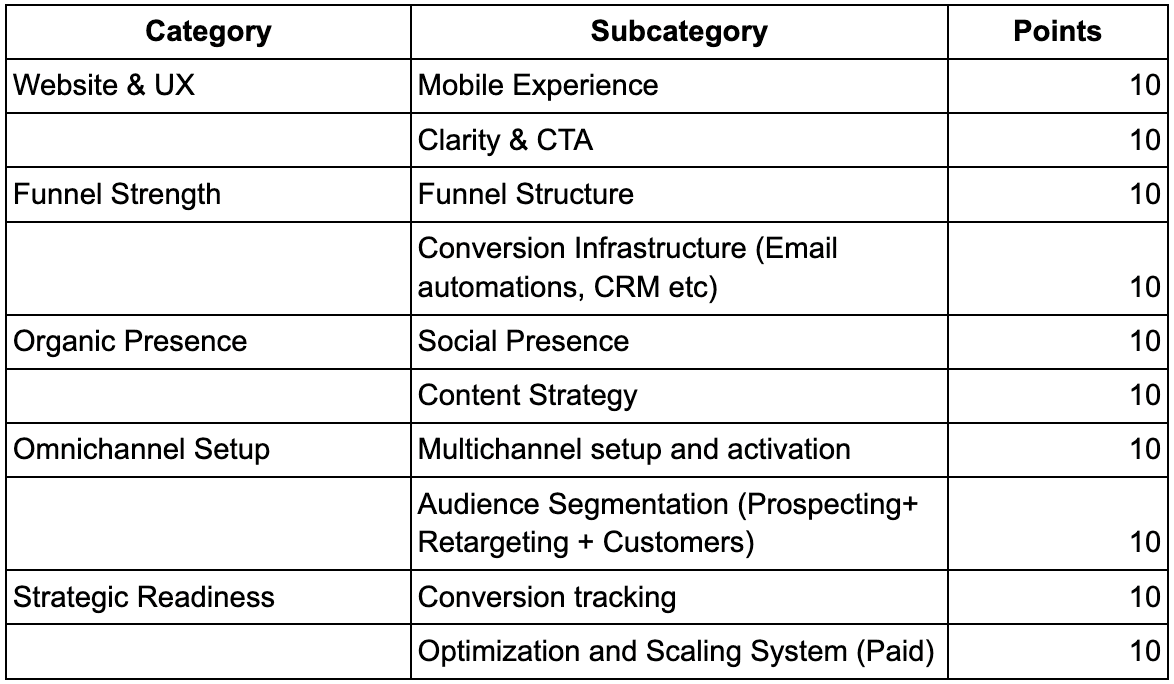
If your score is at least 85, you are in a good place to start with your advertising plan. Anywhere below, you run the risk of blowing ad budget without returns, or losing valuable users due to poor strategy, funnels and bad ad rank.
More journals
Join my newsletter to receive my bi-weekly digest of articles
I read marketing and advertising related articles almost everyday, and I like to share my top insights every two weeks.
Unsubscribe at any time.